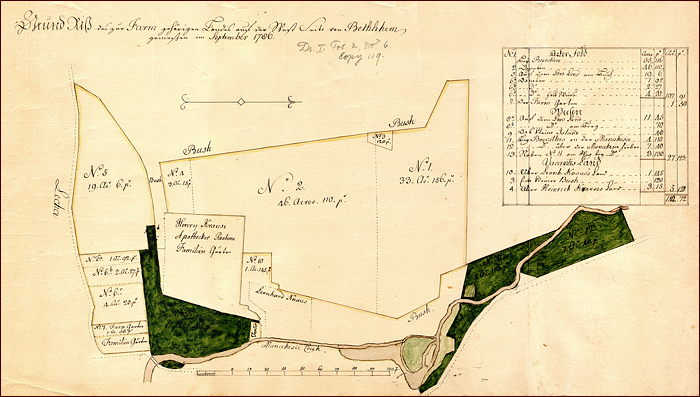
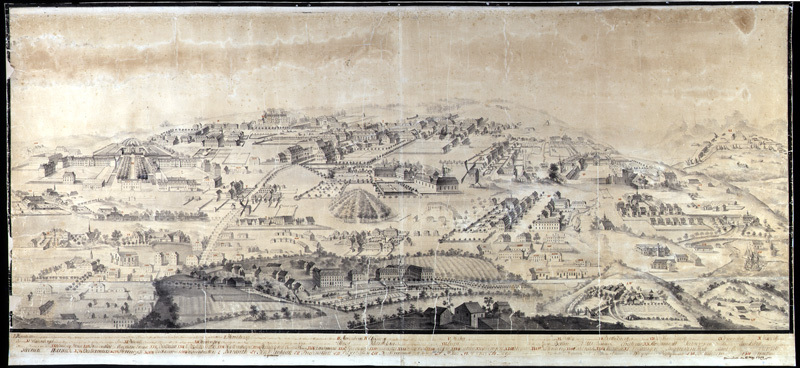
Plan of the farmlands on the west side of Bethlehem, north of the Lehigh, west of the Monocacy as drawn by Georg Wenzeslaus Golkowsky in 1786. Ink and watercolor on paper. Scale: 1 inch to twenty perches.
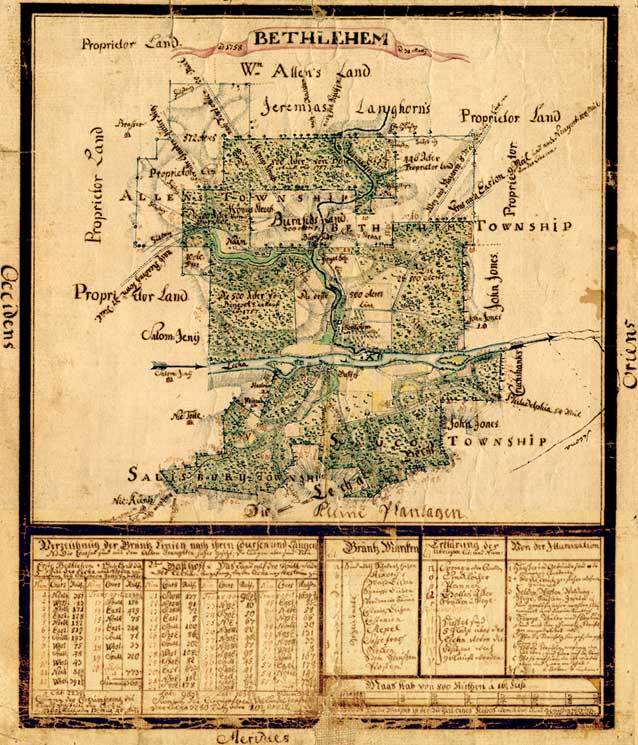
Cartographic material, made with watercolor and ink on paper; backed on linen. Topographical depiction of Bethlehem, Pennsylvania and surrounding tracts.
This map is annotated in German. Included are the lands of Nain, the proprietors, William Allen, Jeremias Langhorn, Burnside, Benezet, John Jones, Nic. Küntz, Nic. Tolle, Weigand, and others.
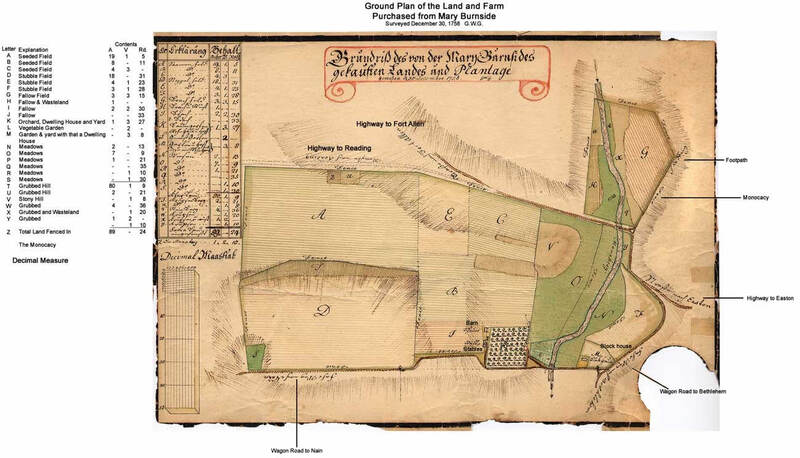
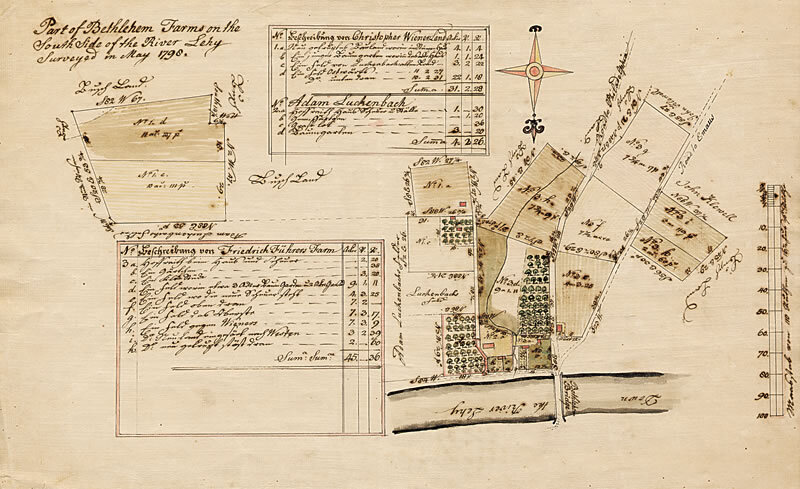
Survey map of the farms south of the Lehigh River by Bethlehem, Pennsylvania, created in 1798. Ink and watercolor on paper linen backed. Scale: 1 inch to twenty seven and a half Ruthen.
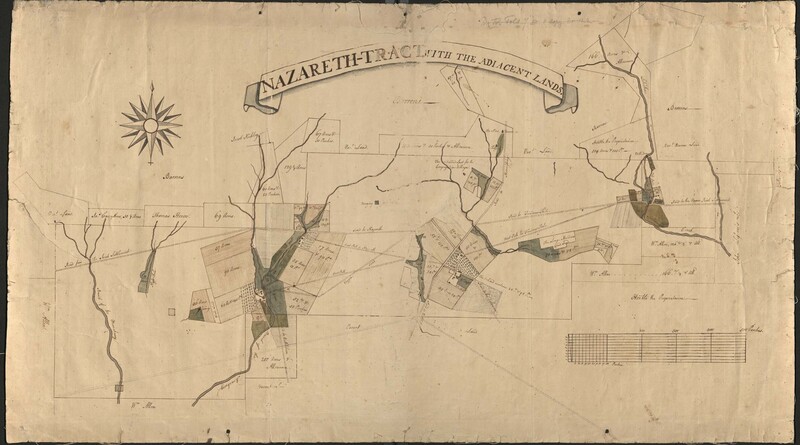
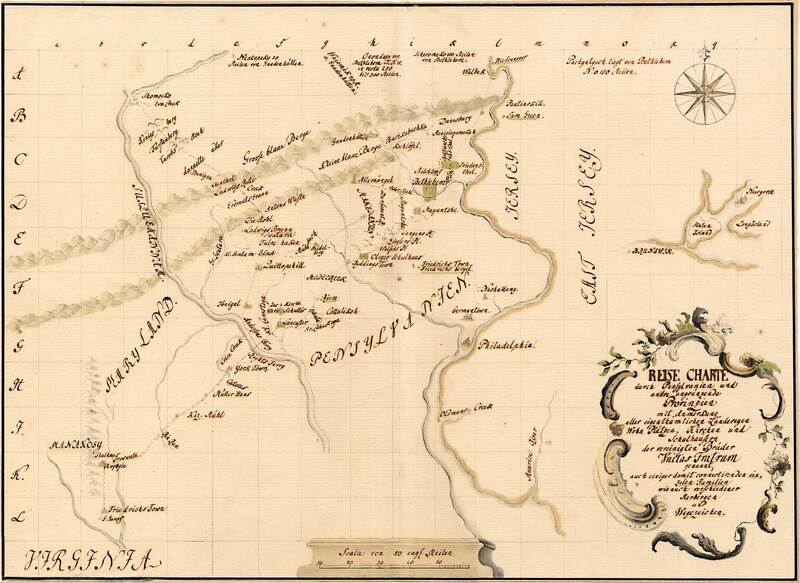
Cartographic material of Pennsylvania, northern Maryland and New Jersey, constructed with ink and watercolor on linen backed paper, and created c.1750. Scale is 1 inch to twenty english miles.
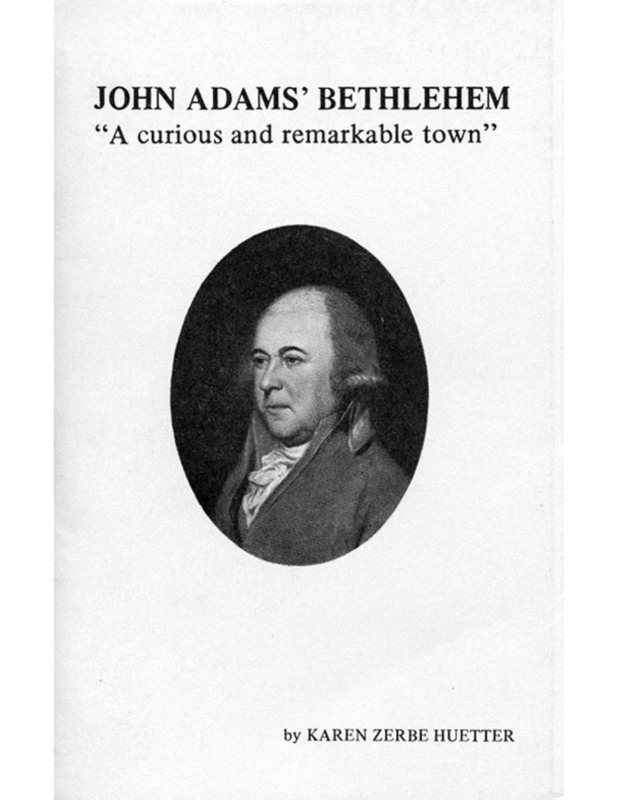
Digitized copy of John Adams' Bethlehem: "A Curious and Remarkable Town" by Karen Zerbe Huetterfor Bethlehem Digital History Project, 2001 by Reeves Library, Moravian University.
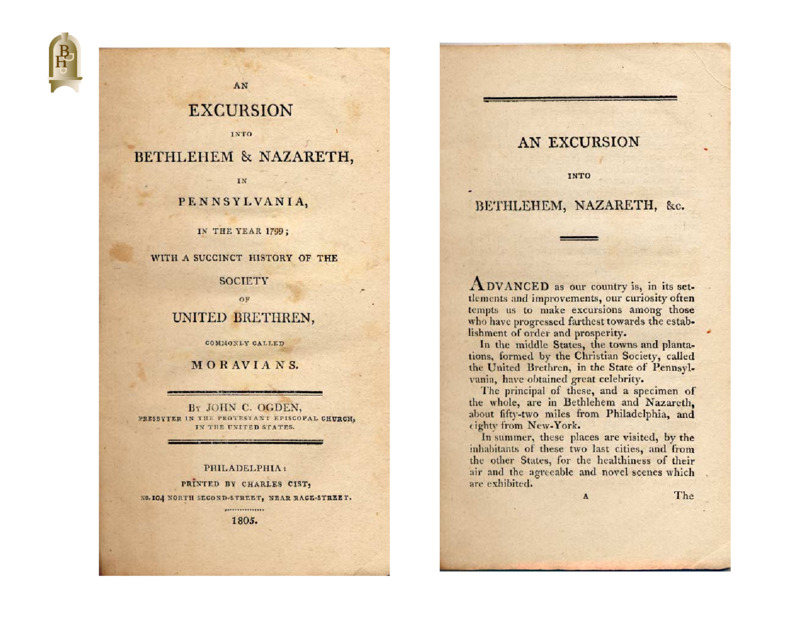
Digitized copy of "An excursion into Bethlehem & Nazareth, in Pennsylvania, in the year, 1799 : with a succinct history of the Society of United Brethren, commonly called Moravians" for Bethlehem Digital History Project, 2001 by Reeves Library, Moravian University.
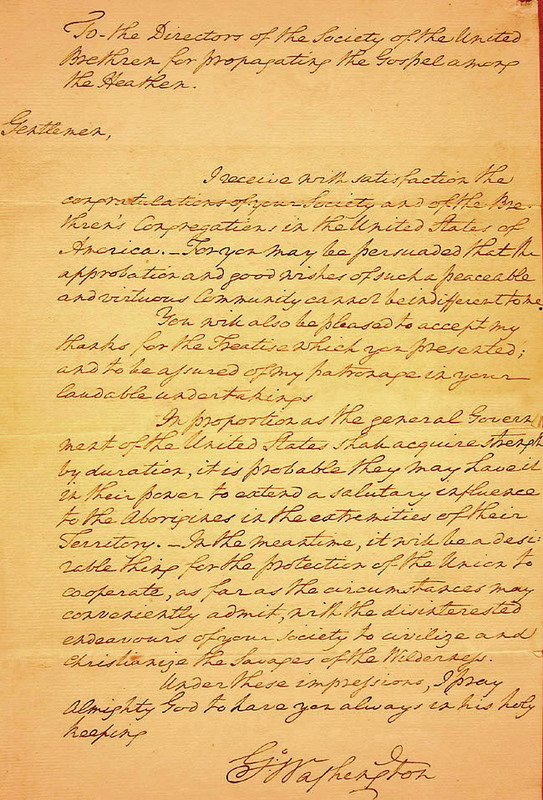
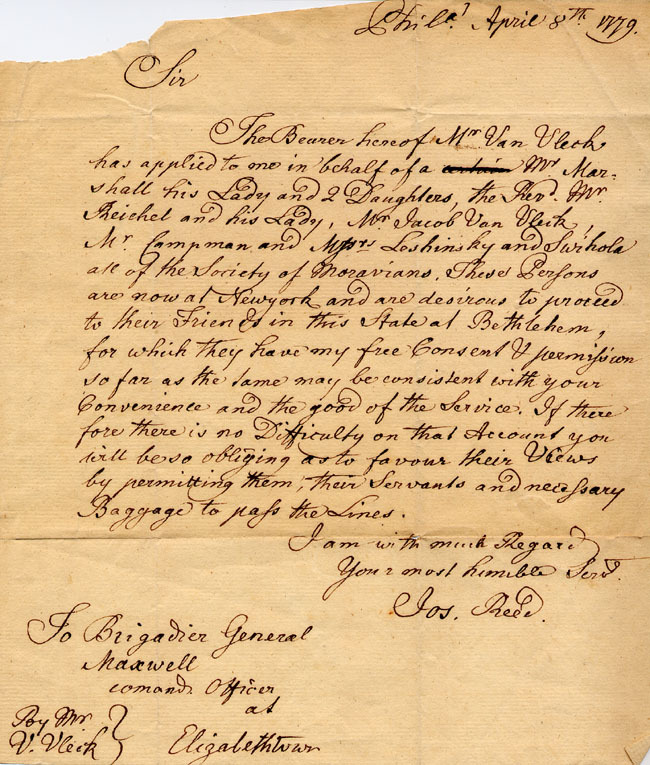
This letter is from the President of the United States George Washington (1732-1799) in reply to a letter sent by the Brethren. Washington thanks them for their congratulations and prayers. He also thanks them for the treatise on the propagation of the Gospel among the Heathen and assures them of the government's cooperation to their missionary endeavors.
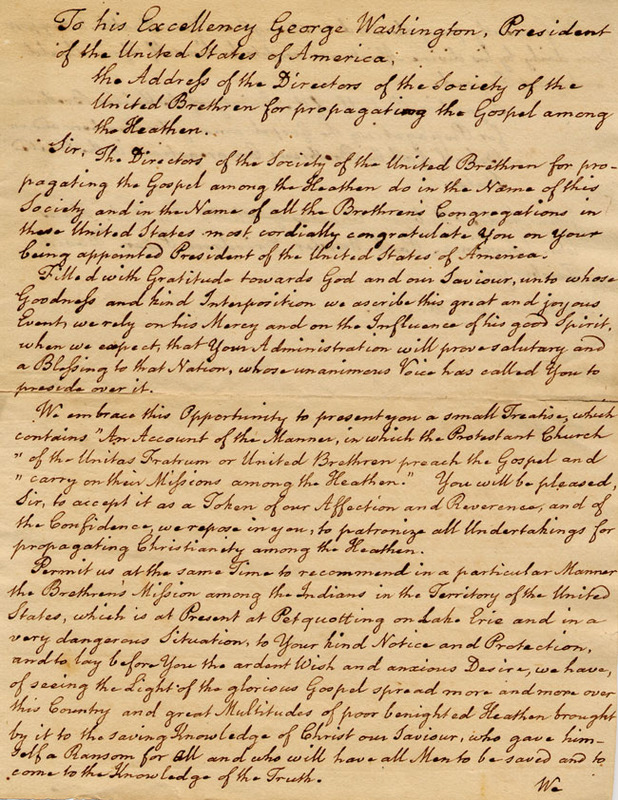
The Brethren congratulate George Washington (1732-1799) on his appointment as President of the United States, mentioning God's intervention in the process. They gift Washington with a small treatise on the propagation of the Gospel among the Heathen. They ask the President for his protection in their missionary endeavors.
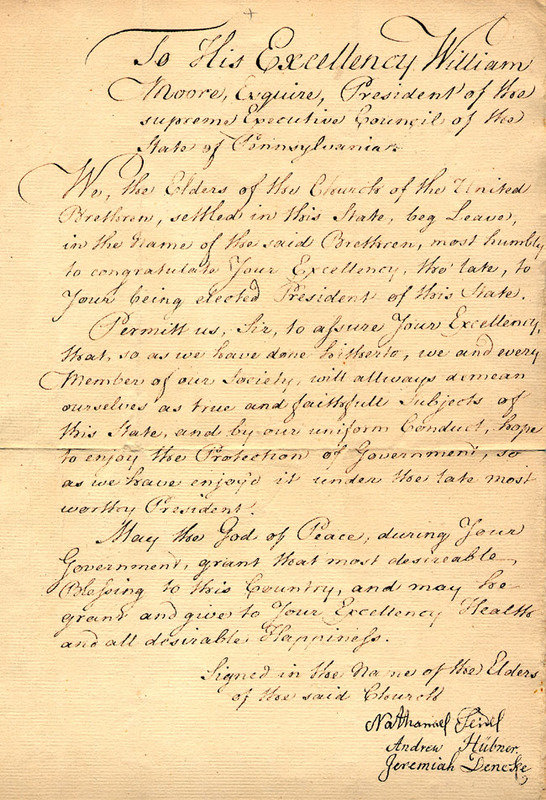
This is a letter from the Elders of the Moravian Church congratulating William Moore (1735-1793) on his election as President of the Supreme Executive Council of Pennsylvania. The Elders pledge allegiance and express their continued hopes for protection of the Brethren.
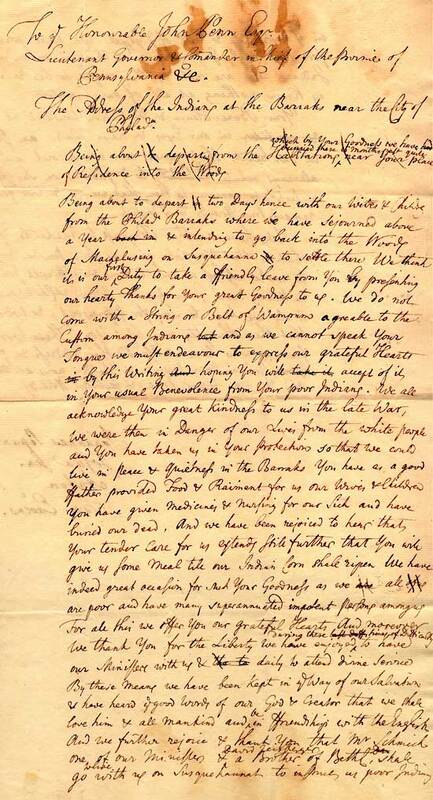
In this letter, the Indians from Philadelphia (under the protection of the Brethren) thank the Governor of Pennsylvania John Penn (1729-1795) for his hospitality and his protection.
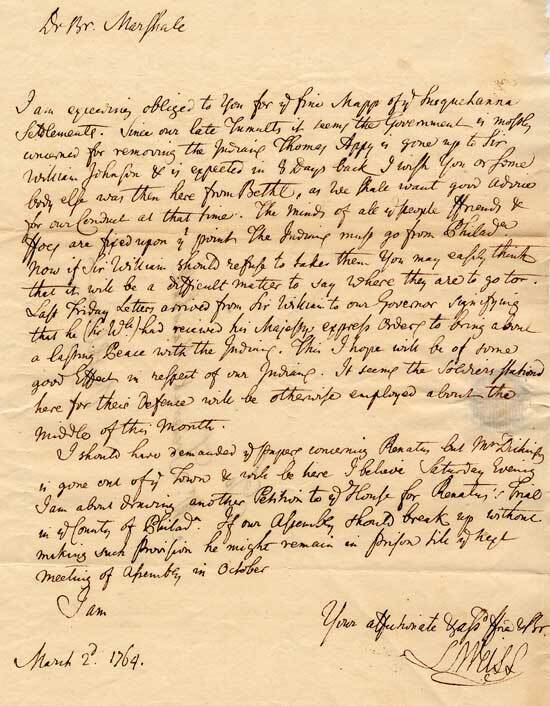
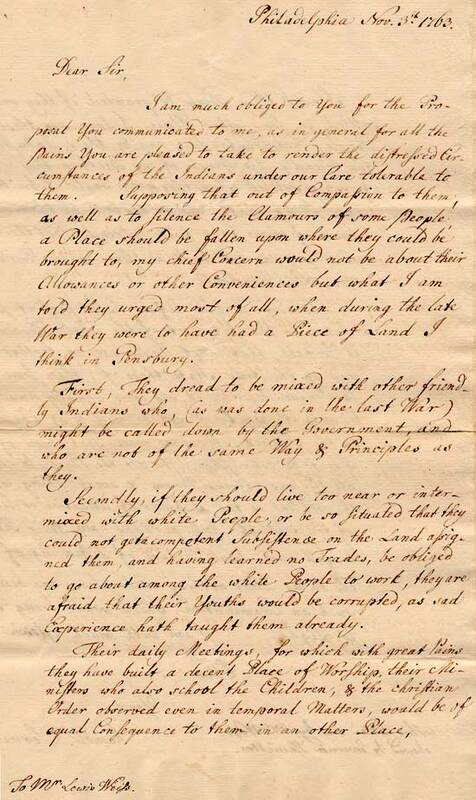
In this letter, Lewis Weiss talks about several issues that the government has with the Indians and he tells Frederick Marshall that he is not sure on what to do next.
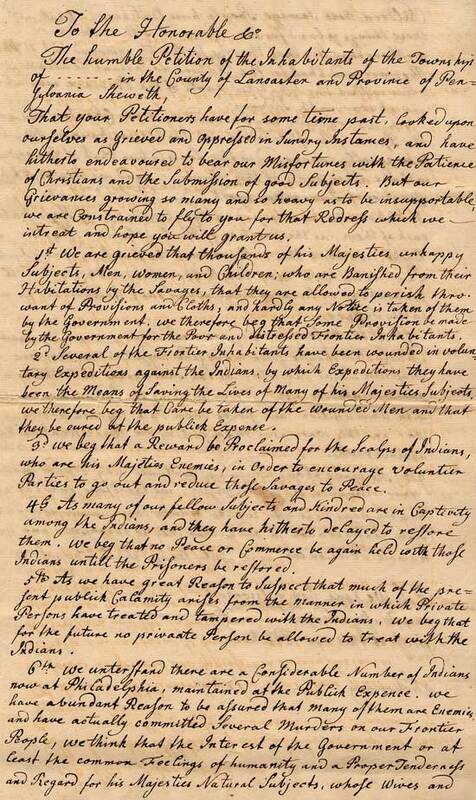
This is a petition to Governor of Pennsylvania John Penn (1729-1795) from the inhabitants of Lancaster County, Pennsylvania. They request assistance in dealing with the Indians in this time of war. They mention that the Moravian Congregation of Bethlehem has been supplying intelligence and supplies to the Indians.
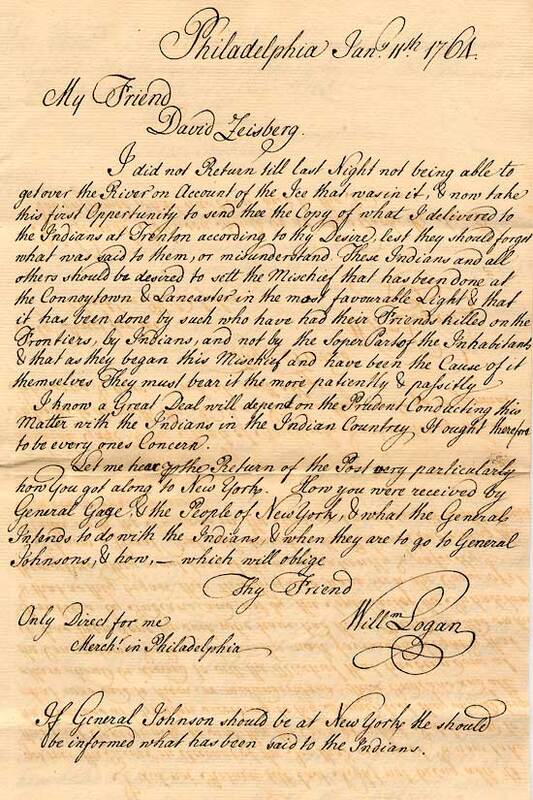
William Logan sends to David Zeisberger (1721-1808), who is in New York, a copy of the message (prepared by Governor of Pennsylvania John Penn) for safekeeping and just in case the Indians need to hear it again.
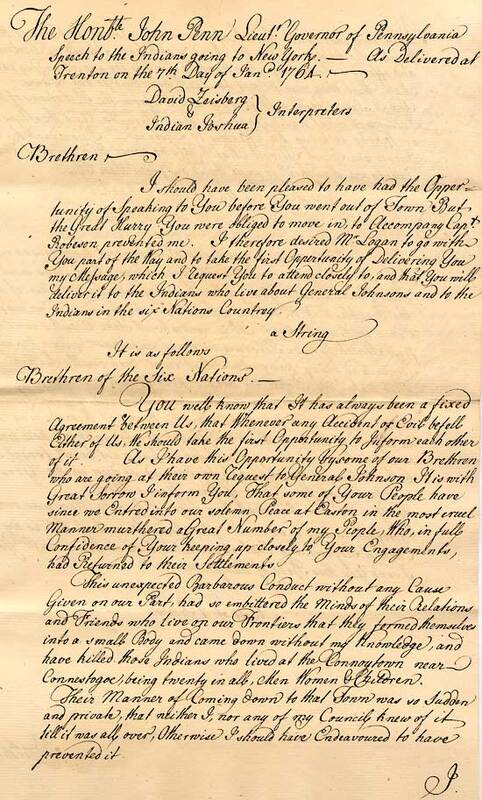
This document is a transcription of a speech prepared by Governor of Pennsylvania John Penn (1729-1795) for the Indians leaving for New York. The message was delivered by William Logan. Penn describes the sorrow and aggravation that each party feels when they kill each other. He promises justice for the Indians killed, offers protection, and proposes for both sides to "bury the hatchet".
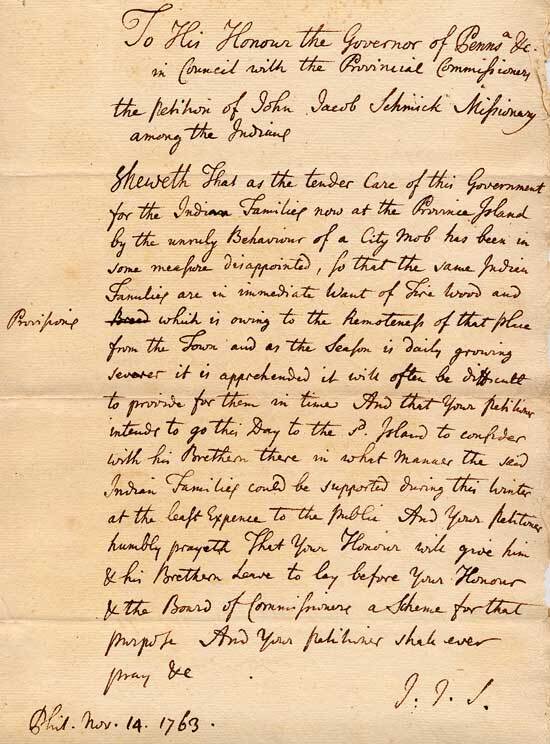
In this petition, missionary John Jacob Schmick asks Governor of Pennsylvania John Penn (1729-1795) for assistance in furnishing supplies to the Indian converts who are under the Brethren's protection.
To His Honour the Governor of Pennsa. &c. in Council with the Provincial Commisioners
The petiton of John Jacob Schmick Missionary among the Indians
Sheweth That as the tender care of this Government for the Indian Families now at the Province Island by the unruly Behaviour of a City Mob has been in some measure disappointed, so that the same Indian Families are in immediate want of fire wood and Provisions which is owing to the remoteness of that placed from the Town and as the Season is daily growing severer it is apprehended it will often be difficult to provide for them in time and that your petitioner intends to go this day to the said Island to consider with the Brethren there in what manner the said Indian Families could be supported during this Winter at the least expense to the public. And Your Petitioner humbly prayeth that Your Honour will give him & his Brethrn leave to lay before Your Honour & to the Board of Commisioners a scheme for that purpose be. And Your petitioners shall ever pray &c.
J.J.S.
Phil. Nov. 14, 1763.
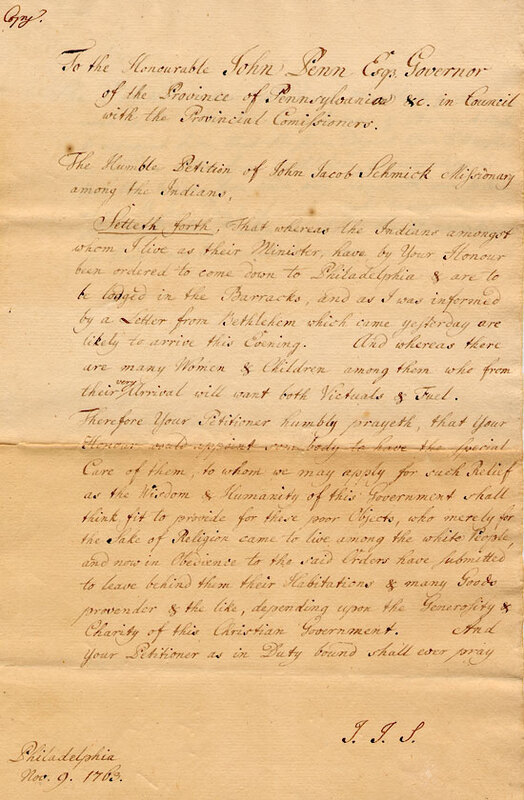
Missionary John Jacob Schmick is asking John Penn (1729-1795), Governor of Pennsylvania, to show hospitality in Philadelphia to the newly arriving Indian converts.
In this letter, Frederick Marshall asks Lewis Weiss for help in finding a place to settle Indian converts as they do not wish to remain living with their tribes nor do they want to settle with White Christians.
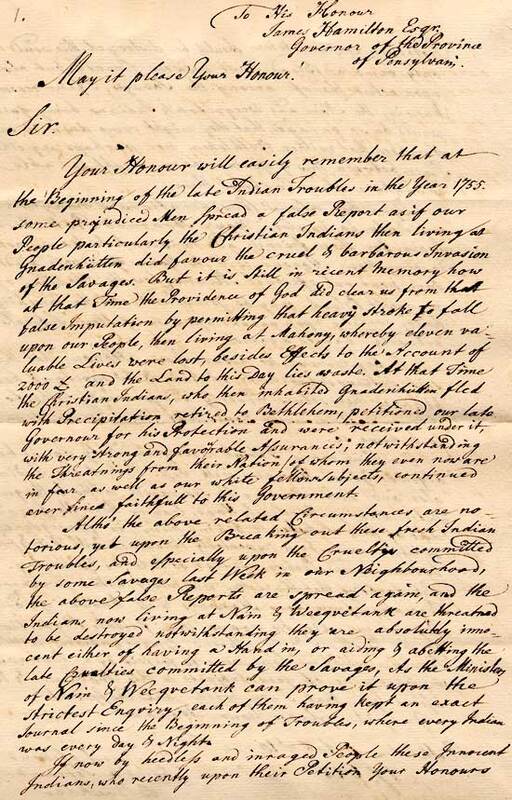
In this letter, Peter Boehler asks Governor Hamilton (1710-1783) for help to protect the Christian Indians from their own tribes but also from the White Christians. Boehler vouches for the good behavior of the Indians living at Nain and Wecquetank. He also asks the governor for protection for the Brethren in the province.
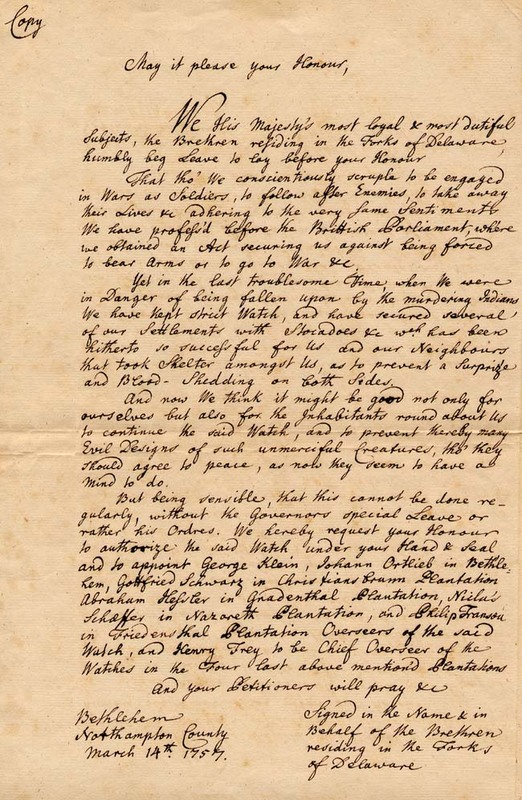
The Brethren residing at the forks of the Delaware ask William Denny (who was Governor of Pennsylvania from 1756 to 1759) for authorization and assistance in setting up a watch to protect their settlements and plantations from being attacked by Indians.
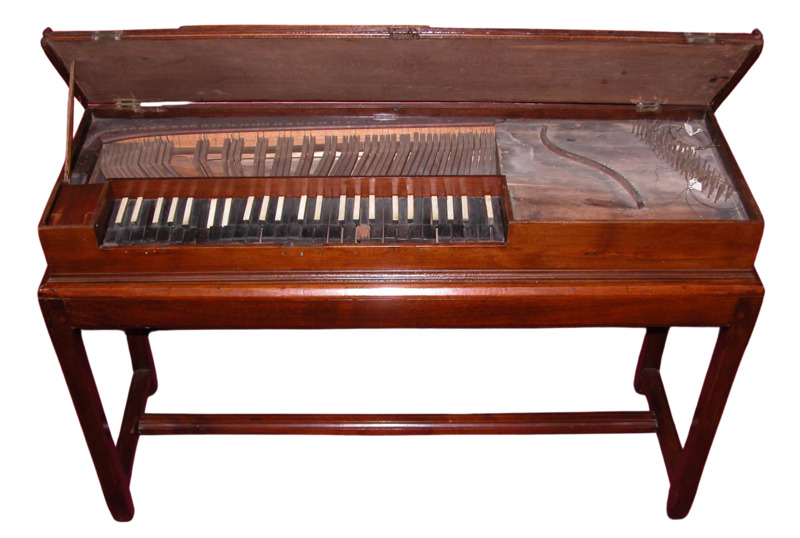
This is the oldest known clavichord made in America, as well as the oldest extant instrument made by David Tannenberg and the only one bearing his signature. Tannenberg built this clavichord while he was apprenticing with John Clemm. Tannenberg would later establish himself as an organ builder however this is a stringed keyboard instrument. A clavichord is a simple box that can sit on a table or rest in a stand with legs, as this one does. The sound is produced by striking the strings with a metal tangent attached directly to one end of the key.
Construction materials include cherry wood, walnut, and pine. From the collection of the Moravian Historical Society, Nazareth, Pennsylvania.
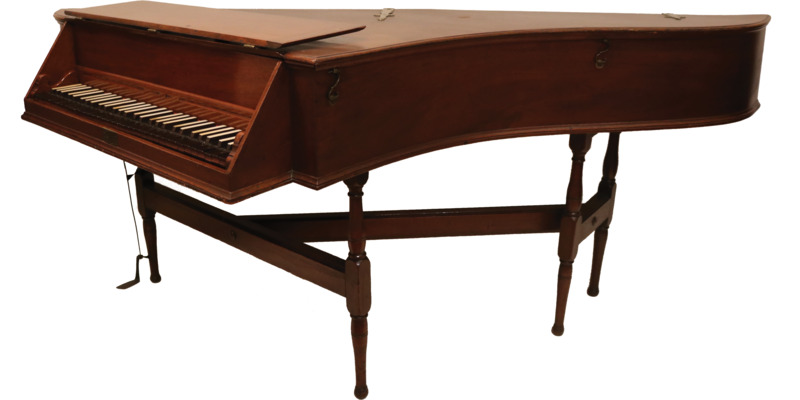
The bentside spinet was a favorite domestic keyboard instrument in the 1700s since it takes up less room than the harpsichord, is less complicated to maintain, and produces a powerful tone. David Tannenberg, renowned Moravian organ builder of Lititz, Pennsylvania, established his reputation building clavichords and pipe organs. This instrument shows that he was also capable of producing plucked-string instruments.
Construction materials include mahogany and coniferous wood. From the collection of the Moravian Historical Society, Nazareth, Pennsylvania.