Fashion
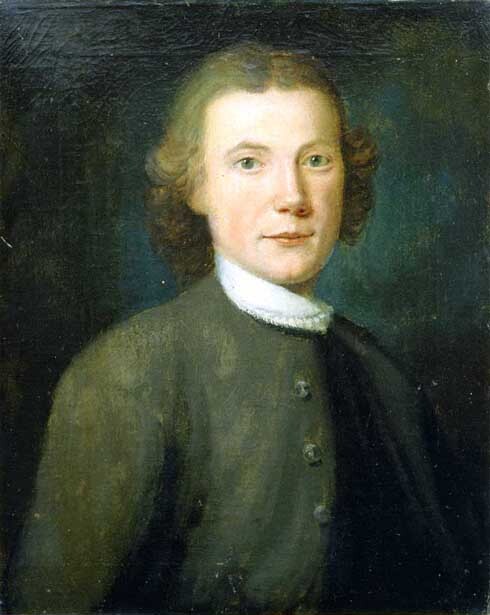
John Ettwein
John Valentine Haidt, John Ettwein, 1754, oil on canvas, 25 in x 17.5 in, Moravian Historical Society, Nazareth, Pa.
18th Century Moravian Dress
During the 18th century, Moravian fashion was defined by a commitment to Christian simplicity, modesty, and communal identity, often lagging behind contemporary secular trends by retaining styles from the 1710s and 1720s well into the late 1700s. Guided by community regulations known as Tracht, Moravian clothing minimized worldly ornamentation, drawing inspiration from European peasant attire where practical undergarments frequently doubled as exterior wear. However, these sumptuary expectations fell disproportionately on women. While Count Zinzendorf maintained that men demonstrated their allegiance to Christ without needing prescribed sartorial rules, allowing Moravian men to dress similarly to non-Moravians in standard round hats, cocked hats (tricorns), or coats, women were subject to strict prohibitions regarding shoe height, excessive ornamentation, and frivolous silhouettes.
Women’s attire was anchored by distinctive modest garments and structured underpinnings that balanced functionality with piety. The defining element of female dress was the Schwestern haube, a tight-fitting cap with a pointed front originated in the 1720s, featuring colored ribbons that signaled age, marital status, and Moravian affiliation (though later mocked by some as the Schnabel haube or "beaked cap" before sparking the Haube Revolt in the early 1810s). To maintain modesty without plunging necklines, women wore tucked or untucked fichus (neck shawls) over stays laced with linen tape or leather binding. Rather than adopting upper-class frivolities like bumrolls for skirt volume, women achieved modest shaping through layered petticoats paired with practical two-panel skirts, embodying a deliberate visual separation from secular vanity.
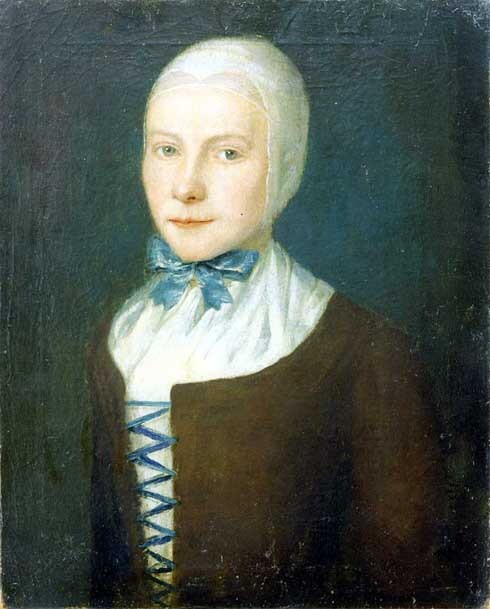
Johannetta Ettwein
John Valentine Haidt, Johannetta Ettwein, 1754, oil on canvas, 21 in x 17.5 in,
Moravian Historical Society, Nazareth, Pa.
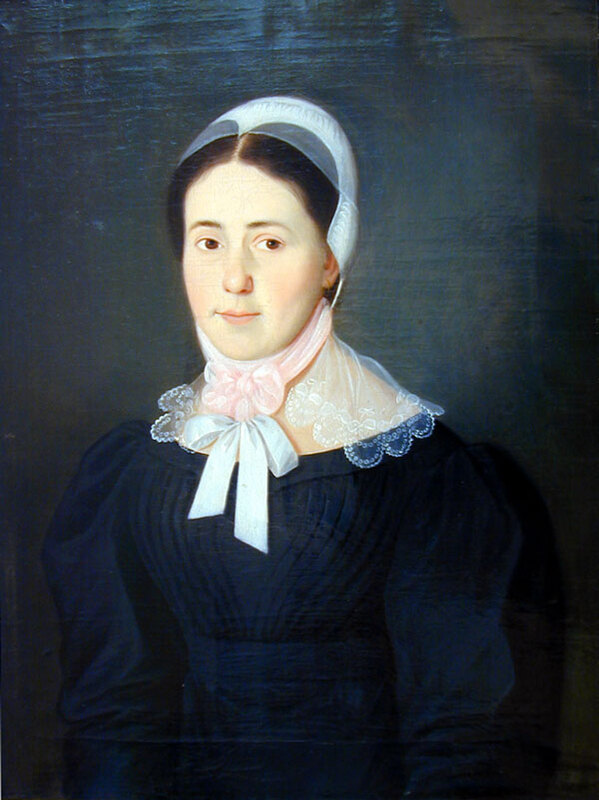
Moravian Single Sister
Unknown Artist, Moravian Single Sister, ca. 1810-1820, oil on canvas, 11.5 in. x 14.5 in., Moravian Historical Society, Nazareth, Pa.
Color Symbolism Used for Bows on Bodices, Tying Haubes
- Green = Single Sister
- Green represented a single sister until 1749/1750. In the 1750s a single sister’s color was pink
- Green was later adopted for single brothers
- Red = Children
- Blue = Married
- White = Widows
- Black = Recommended by Zinzendorf for women who had a “questionable past”
Recomended Sources:
- Podcast: Season 1, Episode 5 of Moravian Mornings: A Living Historian on Moravian Clothing
- Podcast: Season 1, Episode 6 of Moravian Mornings: A Living Historian on Moravian Clothing Pt. 2
- The Haube Revolt: Conflict and Disagreement in the Moravian Community of Nazareth, Pennsylvania, 1815 by Paul Pecker
- Hauben, Waistcoat and Gowns: The Invention of Moravian Identity through Dress in Salem, North Carolina, 1780-1830