Music
Significance of Music to Moravian settlers in early Bethlehem
Moravian music history spans more than 600 years, beginning with the martyr Jan Hus (1369-1415), whom the Moravian Church traces its origins back to. Hus composed music, some of which is still performed today and can be found in the Moravian Book of Worship, such as the hymn “To Avert from Men God’s Wrath” (MBW hymn 416).
The Moravians are also credited with publishing the first protestant hymnal in 1501, which broke from the mainstream tradition of singing in Latin, and instead encouraged congregants to sing in their own languages. This is a tradition that was brought with them to the new world and manifested itself in Bethlehem in the form of “Polyglot Singing,” the unique practice of singing hymns in multiple languages simultaneously. In fact, in one reported instance of this in Bethlehem from 1755, the church service reportedly featured hymns sang in thirteen languages, accompanied by wind and string instruments. The languages were German, English, Bohemian, Dutch, French, Greek, Gaelic, Latin, Mohican, Mohawk, Swedish, Welsh, and Windish.
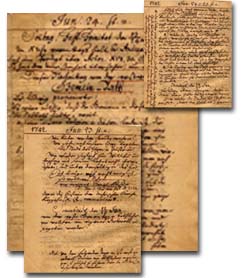
From its earliest days, Bethlehem and music have been synonymous. Even the naming of Bethlehem by Count Nicolas Ludwig von Zinzendorf, leader of the Moravian Church, was done following the singing of the lyrics “Not Jerusalem, lowly Bethlehem” from Adam Drese’s Jesus, Call Thou Me (Jesu, rufe mich) on December 24, 1741.
The Moravian Church, or Unitas Fratrum, as they originally referred to themselves, has always placed an emphasis on combining music with daily living. Music was considered a gift to glorify God, as well as a worthy form of recreation, and therefore singing and performing were considered an important part of both religious and secular life. Music was not only used for church services, but also festivals, ground breakings, and the openings of new buildings. And the Moravian trombone choir, a distinctive musical tradition of Moravian communities, would regularly be used to announce birthdays, deaths, and visitors. The early Moravians were encouraged to sing from the heart in everything they did, even while they worked, and on some occasions, workers were even accompanied by a band to go and harvest crops in the fields.
Despite being a very small and isolated community in the wilderness during the 1700s, the musical life of the young Moravian settlement of Bethlehem was rich and well known throughout the colonies. This was due in no small part to the Moravian Church’s longstanding history and culture of promoting music, which resulted in Bethlehem having a generous population of musically inclined individuals with diverse musical interests, who worked as copyists, instrument makers, and who regularly performed music. They followed the latest musical trends in Europe, in the colonies, and they wrote their own compositions. As a result, Moravian composers in Bethlehem during the late 1700s and 1800s created thousands of original works including brass ensembles (especially with trombones), sacred vocal music for worship services, hymns, and secular chamber and ensemble music for recreation, which are preserved today by the Moravian Music Foundation.