Unheard History: Uncovering Moravian University's Musical Heritage
Hello! My name is Holly and this past summer, another student intern and I created a digital catalogue of any on-site historic musical instruments found in the UNESCO World Heritage buildings.
Doing so allowed us to explore all sorts of places students don't normally get to go, like the attics and basements of Central Moravian Church and the Single Brethren's House. But it was one room in particular where hit the jackpot on finding musical instruments: the "Washington Room" in the Single Brethren's House.
Named after our first president, this room houses five instruments, ranging from 1763 to 1976. Unheard History: Uncovering Moravian University's Musical Heritage gives you unique access to each one. Let's get listening!
Women's Instrument in a Man's Space
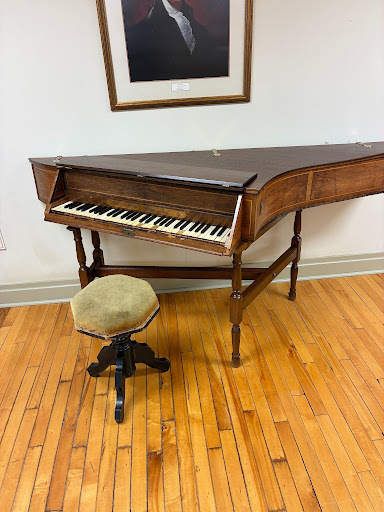
For our first object, we are featuring the oldest instrument in the room, the English bentside spinet. An English bentside spinet is a plucked keyboard instrument from the harpsichord family. It gets its name from the diagonally angled strings and bent case side, as opposed to traditional square pianos.
This instrument was originally constructed in 1763 by Baker Harris (c. 1724-1783), a well-known London harpsichord maker. It was later restored in the 1980s.
The spinet was sent from England for a "Mr. Eshleman of York, Pa." The York Musical History reports that there were four harpsichords in York at the time of the Revolution and the penciled inscription says this one was the first instrument “of piano order” in York County. Subsequent owners were Major Bent, Mr. Duhling, and Felix B. Schraedley of Middletown, Pa., who acquired it in 1867.
A letter from R.H. Schraedley, a grandson who remembers seeing it as a boy, reports that it came into the possession of his cousin Louise, who married a doctor in Bethlehem. He does not remember the name.
This instrument came into the possession of the Moravian Seminary and College for Women sometime in the beginning of the 20th century. Dr. Richmond Myers remembers that the spinet was at the seminary in the 1920s, and also that the daughter of a doctor named Straub taught piano at the seminary.
What's interesting to me is that now the spinet is located in the Washington Room in the Single Brethren's House. The building was constructed by Single Brethren's choir in 1748 and housed them until 1815. On tours of South Campus, guides emphasize how the building was converted into a hospital for the Continental Army from 1776-1777. Yet it functioned as the Female Seminary from 1815-1954, over twice as many years. Despite being framed in a very male setting currently, the spinet and other keyboard instruments were some of the only instruments considered acceptable for women to play. My one professor jokingly called keyboards a "hookup spot" because women would play to entertain their guests and hopefully attract a husband in the process.
While there is a small exhibit detailing the history of women's education at Moravian University (formerly Moravian College), I can't remember hearing about it from the tour guides. I'm embarrassed to admit this, but I don't think I've even fully read the exhibit didactics. As a music major who's in the Single Brethren's House on a daily basis, the exhibit has sort of become background decoration to me.
After spending a summer semester reseaching historic artifacts and learning about Bethlehem's history though, I wonder how can we change this interpretation, especially now that the Single Brethren's is part of a World Heritage designation that emphasizes women's education?