Hannah Sophia Robbins (1823-1856)
- Name:
- Hannah Sophia Robbins
- First name:
- Hannah
- Add Name:
- Sophia
- Last name:
- Robbins (birth)
- Birth date:
- 1823-11-28
- Birth place:
-
Saint Johns, Antigua
- Death date:
- 1855-02-05
- Death place:
-
Fulneck
- Gender:
- Female
- ML ID:
-
mlper000266
Relations (family):
- George Robbins, parent
- Martha (Stowe) Robbins, parent
- John Frederic Robbins, sibling
- George Robbins, sibling
- William Robbins, sibling
- Mary Robbins, sibling
- Martha (Schick), sibling
- James Robbins, sibling
Memoir:
- Archive: Fulneck Archives
- Shelfmark: "Ful/SS/54", "Ful/3/125"
Hannah Sophia Robbins was born on November 28, 1823, in Saint John's, Antigua, to missionary parents, and spent her adult life navigating the tensions between her professional roles as a governess and the spiritual expectations of the Moravian community. Her biography is notable for its candid depiction of her worldly inclinations and a naturally irritable temperament, which the narrator frames as a spiritual obstacle eventually overcome through the refining process of a terminal illness. After a decade of fluctuating health and spiritual struggle, she achieved a state of resigned assurance and died on February 5, 1855, at Fulneck, at the age of thirty-one, having requested the hymns "Rock of Ages" and "Jesus, Lover of my Soul" in her final hours.
View Transcription of Memoir
1
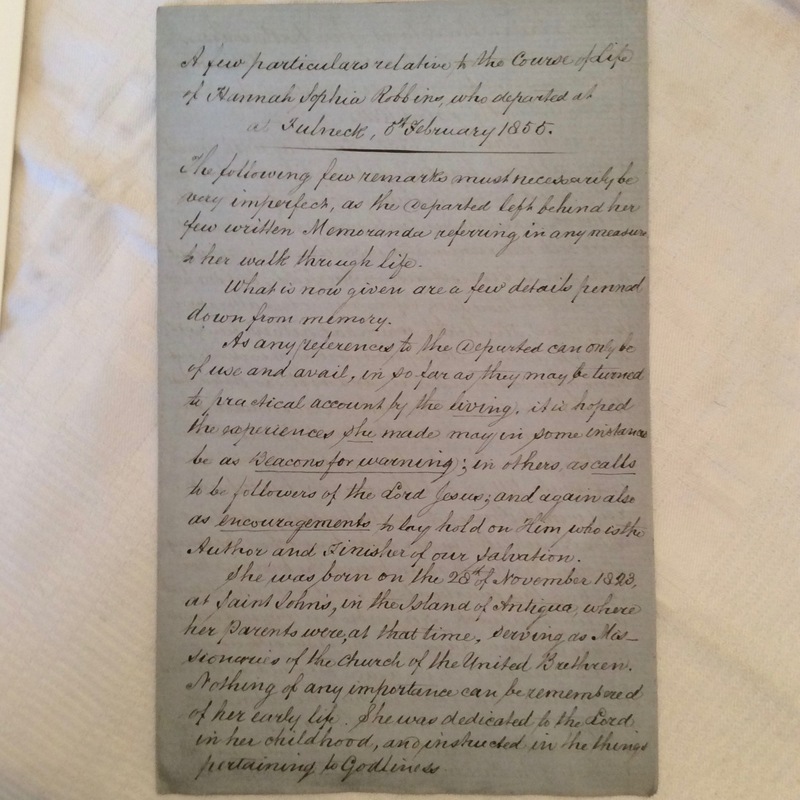
A few particular relative to the Course of Life of Hannah Sophia Robbins who departed at Fulneck, 5th February 1855.
The following few remarks must necessarily be very imperfect, as the departed left behind her few written Memoranda referring in any measure to her walk through life.
What is now given are a few details penned down from memory.
As any references to the departed can only be of use and avail, in so far as they may be turned to practical account by the living, it is hoped, the experiences she made may in some instances be as beacons for warning; in others, as calls to be followers of the Lord Jesus; and again also as encouragements to lay hold on Him, who is the author and finisher of our Salvation.
She was born on the 28th of November 1823, at Saint Johns, in the Island of Antigua, where her parents were at that time serving as Missionaries of the Church of the United Brethren. Nothing of any importance can be remembered of her early life. She was dedicated to the Lord in her childhood, and instructed in the things pertaining to Godliness.
2
Her stay in the Island of her birth was of six years duration; until her Father and Mother were called in December 1829, to superintend the Mission in the Island of Saint Kitts.
In the Spring of 1833, she along with several other children, was brought to England for education, and placed in the Boarding School in this settlement, when in her tenth year. She remained there till the summer of 1838, when she moved to the Single Sisters House in Fairfield; but she had not resided there long before an evident alteration took place. Her health, which had hitherto been good, began to decline. Many means were resorted to, but none appeared to restore it; and as it was stated that the climate did not agree with her constitution, she was removed in 1843 to the Single Sisters House in this place. Her stay here continued, with few intervals, till 1845. In this year she left Fulneck, and went to Harrogate for the purpose of assisting Miss Hinchliffe, in her Boarding School for young ladies. Her health again proved the barrier to her holding this situation long, and soon she returned again to Fulneck. An unbroken course of seven years was now passed in the Sisters House.
In February 1853 she again obtained a situation as governess in a family residing at Heaton, near
Bradford; for rather more than a year she lived here, and gained the confidence of the parents, and the affection of the children. During this time she was
3
resisting the gradual but fatal decease with which she was visited. It proved, however, more than she could bear; and, entirely prostrated by it, she was brought home very ill.
Under prompt and efficient medical attendance and care, which were blessed by God, she so far rallied that she was able to assist a little in giving instruction in the Girls Day School. As long as her strength would permit her, she persevered; but about the middle of December last, she felt herself constrained to desist; and then it appeared evident to all that her departure was nigh at hand. Lingering, and yet struggling on, she wasted away, her existence almost a burden. And this she continued until it pleased the Lord to liberate her from her suffering, on the morning of the 5th of February.
With regard to her Christian experience, we would state the following.
During her early years, and throughout her residence in the Boarding School in this place, she
never (that she could recollect) had any distinct feelings of drawings of Grace; and falling into the ways of the young, thought little of Christ and her soul's salvation. In such a state of mind as this, she left Fulneck, and entered the Single Sisters House in Fairfield. Here, as before stated, her bodily health began to fail; but here also it was that her first and abiding religious impressions were made.
4
It pleased the Lord to work upon her heart with His Spirit. The influences felt were always remembered; and it was while receiving instruction preparatory to her admission to the Lord's Supper, and during the hour of her confirmation, the feelings of Love to her Saviour were strongest. When in serious mood, she always looked back to this time with pleasure, and frequently asserted that she derived much good and blessing from the discourses of the late Br. Thomas Mallalieu, who was then Minister of the Congregation.
From this date a long blank appears. Satan was evidently striving hard to root out the good seed, and ofttimes to human eyes, had succeeded.
She was often then drawn by Godless companions into a frivolous and unsettled frame of mind; looking for pleasure to the things and the people of the world, more than to the things and the people of God. There was at the time alluded to a craving after these things in her own heart, so that worldly schemes were speedily and cordially em braced and engaged in. Her naturally reserved disposition prevented her at times from giving expression so much that she felt whatsoever she did say in respect to her state of heart we believe was strictly truth. Her thorn in the flesh was no doubt irritability of temper; but this might be partly traceable
5
to her bodily condition, and the influence of the malady with which she was affected.
In the February of last year she returned home much reduced in strength, and for a time thought her end was near. Hope however soon revived. Still she clung to life, and longed for health. From this time we think we may date a work begun, and we trust completed, in her by the hand of God. The finger of the Lord was gradually writing Saved upon her heart. A change in her sentiments, her feelings, and her temper was soon perceptible. Less of a worldly tone marked her conversations. Her thoughts were more firmly fixed upon her soul and God. The irritability of temper gave way; and resignation, affection, and gratitude characterized her. It was evident the work of grace had fully set in. Still she despaired not of life. The complaint, deceptive in its working, often deceived her. At times the hope of recovery almost amounted to confidence
and then again doubt and gloom took possession of her.
In December last the closing conflict began; the days of her pilgrimage, it was evident to all, were numbered and few. She now became more resigned to the will of God concerning her, and was at this time very anxious to improve the public means of grace that presented themselves. Her attendance at the Chapel was often against advice, but she would go, and no doubt received much blessing. The last Communion in the old year was one of very great enjoyment to her soul, and then she was almost too
6
weak to stand. It was the last time she stood to worship God in these his earthly courts. The ripening for Eternity was now rapid. There was a craving for the food of life; and her language was, yet more, yet more, she could not be satisfied, the cup could not be filled to overflowing. All who were willing to lead or point her to Jesus were welcome. Kind friends were not wanting. To such she was grateful to the last; and as Christ has said, "Whosoever shall give a cup of cold water to one of the least of these my disciples shall in no wise lose his reward," their labour of love and their words shall be rewarded hereafter.
There were several whom she was always peculiarly anxious to see, the Sisters Hunting and Haster in particular. Among them was also our dear Br. Libbey, whose conversation was relished, and whose advice was willingly and thankfully taken. She regretted very much she could not see him once more before she died. In all these things we believe her confidence was not in man, but in God. She had many conversations with her Labouress after the idea of her recovery had passed away. On one occasion, upon her remarking, "She had no hope of her health returning, and no wish that life should be prolonged, but a desire to depart and be with Christ;" it was asked; Upon what do you ground your hope of acceptance? Is it on that desire to depart? Or on any good in yourself? She replied with firmness "Oh, No." Do you feel that
7
the blood of Jesus
alone, His finished work on the Cross, can save you from eternal death? "O Yes" she replied, "that is all my hope, I have never been able to express my feelings in words, but I think the power will come."
She frequently desired the prayers of her friends, and said "She desired the company of none but those who would converse with her on the concerns of her soul." In review of her past life, the wish that she had lived more to the glory of God seemed to possess her mind and fill her with humility. On a message of affection from her dear absent Minister (Mr Libbey) being given to her, that he hoped she was enabled to adopt the language of the verse of No 418, "In thy wounds, O Jesus" and she said "I can." She was sometimes tempted to regard her bodily sufferings as a barrier between herself and that full tide of love she longed should flow towards Him who died to redeem her. At another time she said "Yesterday I felt our Saviour be so very precious to me." You could cast all your hopes and fear on him? it was asked "Yes I could." She then mentioned the comfort she had derived from reading & meditating on the 14th Chapter of Saint John's Gospel. On Sunday afternoon she was very weak and languid, and greatly dreaded the last struggle between soul and body. She was encouraged to believe that the Lord would spare her by taking all pain away at that solemn moment,
8
and shew Himself near her in the dark valley. She took comfort and said "It is only the breaking up of the earthly tabernacle" and added that "she had no fears beyond the grave."
Last Sunday Br Willey visited her. She felt encouraged by his words, and desired him to call again, little thinking that her end was so near.
Throughout the night she was unusually restless, and, when a little composed, was anxious that her father should read and pray with her. He did so, and when prayer was ended, she requested two hymns to be read, viz; "Rock of Ages, cleft for me" and, "Jesus, Lover of my Soul"
She lingered on till morning, and when her dissolution was known to be at hand, Br Willey was sent for, who prayed, and blessed her for her departure. About half past eight she gently fell asleep, after a pilgrimage of 31 years and 2 months.
Her hope, we believe, was firmly anchored within the veil, and the language of her experience is "Remember now thy Creator in the days of thy youth, while the evil days come not, nor the years draw nigh, when thou shalt say, I have no pleasure in them."